






What Research Says About Training at Home
The science is in. Home training is not a compromise. It is a legitimate, evidence-backed approach to building fitness.
The question used to feel rhetorical. Can you actually get fit at home? Not just maintain a base level of activity, but genuinely build strength, improve cardiovascular capacity, and produce real physiological change. The research is now extensive enough to stop hedging. Yes. The answer is yes.
This isn't a commercial for home fitness. It's a summary of what controlled studies consistently show when they compare resistance training environments. The findings are more definitive than the fitness industry, which profits from gym memberships and large equipment, has any interest in advertising.
A 2021 review published in the International Journal of Environmental Research and Public Health examined multiple studies comparing home-based and gym-based exercise programmes. Across measures of muscular strength, endurance, and body composition, the differences between groups were not statistically significant. The training environment wasn't the determining variable. Effort and progression were.
"The research keeps returning to the same finding: the environment matters far less than the effort applied within it."
The strongest body of evidence comes from resistance training studies using bodyweight and elastic resistance. Elastic resistance, bands, has been studied extensively as a substitute for free weights and machines. A 2019 meta-analysis in the Journal of Human Kinetics concluded that elastic resistance training produces comparable gains in strength and muscle mass to conventional resistance training when progressive overload is applied. The mechanism of adaptation is the same. Only the tool differs.
Bodyweight training research tells a similar story. Studies examining progressive calisthenics programmes show measurable hypertrophy and strength improvement over eight to twelve week periods, comparable to matched protocols using external resistance. Using only body mass doesn't eliminate the stimulus. It changes the method of applying it.
The variable that actually predicts resultsAcross the research on training environment, one variable consistently predicts outcome better than equipment access, facility quality, or programme complexity: adherence. The training that produces results is the training that happens. Not the training that is theoretically optimal.
Studies on exercise adherence consistently find that proximity and convenience are among the strongest predictors of long-term consistency. People who train at home report fewer barriers to session completion, lower rates of programme dropout, and higher rates of sustaining training behaviour across twelve months compared to gym-based cohorts. The gym offers advantages in equipment variety and social environment. It also costs a commute that, for many people, works as an attrition mechanism.
"Adherence predicts results more reliably than any programme variable. Training at home removes the single most common reason people skip."
The research doesn't argue that home training is superior to gym training. It argues that it's equivalent for the majority of fitness goals, and that the practical advantages of proximity and consistency may make it more effective for most people. The ceiling of home-based training is higher than widely assumed, and the floor is lifted significantly when equipment is designed for progressive overload rather than passive use.
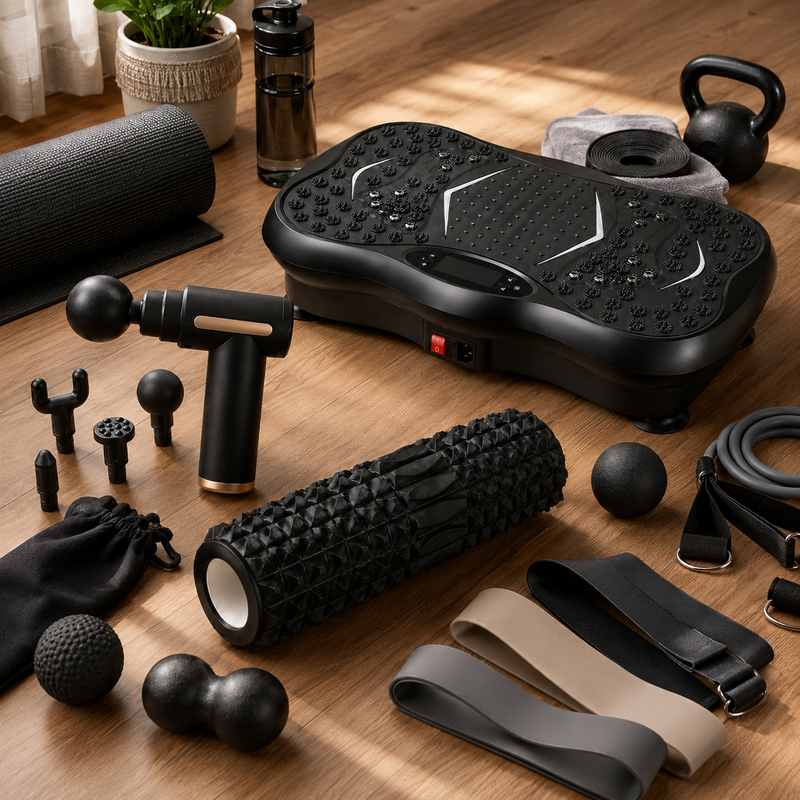
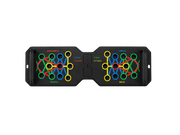
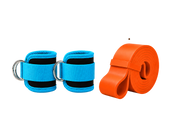
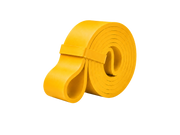
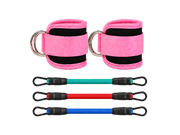
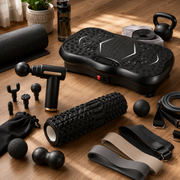
A resistance band set with genuine progression across resistance levels. A compact platform that allows explosive movement without impact. A roller and a few targeted recovery tools. These aren't compromises. They're a complete system, one the research consistently validates. The data has been in for some time. The question is simply whether you use it.
What home training must includeA home programme needs the same principles as any other programme: movement balance, progression, recovery, and enough intensity to create adaptation. Without those, home training becomes random activity. With them, it becomes a legitimate system.
Movement balance means not only doing the exercises that are convenient. Many people overdo pushing movements because push-ups are easy to set up, while pulling patterns get ignored. Bands solve that problem by making rows, pull-aparts, pulldowns, and rear-delt work possible in small spaces. Lower-body work also needs intention: squats, lunges, hinges, calf work, and single-leg variations can all be progressed without large machines.
Recovery also belongs in the system. Home training often makes it easier to train more frequently, but that can become a problem if every session is hard. A good home routine includes lighter days, mobility, and tools that help the body stay ready.
How to measure progress at homeProgress at home should be tracked clearly. More reps with the same form is progress. A harder band is progress. Slower control is progress. Shorter rest with the same performance is progress. Better range of motion is progress. Less soreness from the same workload is also progress.
The mistake is measuring home training only by weight lifted. Weight is one form of overload, not the only form. Tempo, leverage, volume, density, and control all change the demand placed on the body. When these variables are tracked, home training becomes much more precise.
The research supports home training when effort and progression are present. The practical challenge is making those variables visible. Once they're visible, they can be improved.